

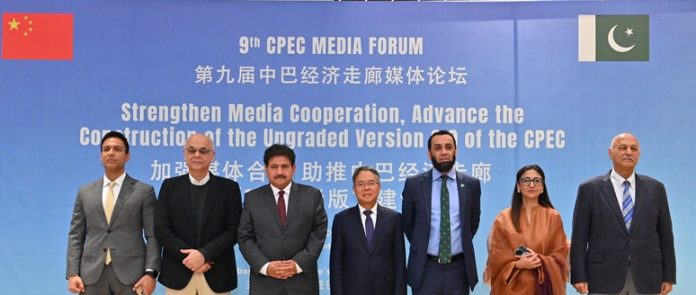

ISLAMABAD, Dec 24: Ambassador of China to Pakistan Jiang Zaidong on Tuesday said the Pakistan–China friendship will continue to deepen with the passage of time, as both countries advance cooperation under CPEC 2.0 and jointly counter misinformation targeting their partnership.
Addressing the 9th CPEC Media Forum, jointly organized by Pakistan-China Institute in collaboration with China Economic Net and the Embassy of the People’s Republic of China, the ambassador said media cooperation has become central to building fact-based narratives around the China–Pakistan Economic Corridor (CPEC) and confronting the growing challenge of disinformation.
Jiang reiterated China’s firm stance on the one-China principle, stating that Beijing “cannot tolerate any person or force” seeking to split Taiwan from China, and praised Pakistan for its “consistent and principled support” for China’s sovereignty and territorial integrity.
Recalling that the media forum was founded in 2015 alongside the launch of CPEC following President Xi Jinping’s historic visit to Pakistan, he said renewed high-level exchanges reflect consensus to transform CPEC into a comprehensive, multi-sectoral flagship project under the Belt and Road Initiative.
Outlining priorities under CPEC 2.0, the ambassador highlighted agriculture, mining, and industry as key focus areas, with special emphasis on export-oriented projects and initiatives that directly improve people’s livelihoods.
He pointed to industrial parks, textile investments, Gwadar connectivity, and social-sector cooperation, including medical equipment and training, as tangible examples of deepening collaboration.
Stressing the power of information, he praised journalists for countering distortions with facts, describing the pen as a modern-day sword in the battle against falsehoods.
Federal Minister for Information and Broadcasting Attaullah Tarar described Pakistan–China relations as a lived national experience, shaped through decades of exchanges. Calling the bond “unique,” he said no other relationship could claim the depth symbolized by the term “iron brothers.”
Tarar underscored the need for modern, digital-first communication strategies, citing reforms such as Digital Pakistan TV, and urged closer collaboration with Chinese media, influencers, and businesses to tell the CPEC story more effectively.
He proposed the creation of a dedicated fact-checking platform under PCI to counter false narratives surrounding CPEC.
Zheng Qingdong, President and Editor-in-Chief of Economic Daily, said CPEC has evolved from a blueprint into reality and entered an upgraded phase.
He called on media in both countries to present a truthful, multidimensional picture of CPEC, counter smears, and help translate leaders’ consensus into public understanding, noting that 2026—the 75th anniversary of diplomatic ties—should mark a new milestone in bilateral relations.
Broadening the discussion to cultural exchange, Yang Chunyan, Deputy Editor-in-Chief of Foreign Languages Press, emphasized the enduring role of publishing in shaping people-to-people ties.
She highlighted joint translation projects, including the Urdu edition of Xi Jinping: The Governance of China, and proposed new initiatives such as mutual classics translation programs, e-books, audiobooks, and expanded new-media cooperation to build a “humanistic ecosystem” for CPEC 2.0.
Senator Mushahid Hussain Sayed, Chairman of the Pakistan-China Institute, said misinformation and information warfare pose strategic challenges to the Pakistan–China partnership.
He noted that 2025 and 2026 mark key anniversaries for China and Pakistan, urging both sides to use these milestones to further strengthen an all-weather, all-encompassing relationship.
The forum brought together senior officials, diplomats, media leaders, and representatives of Chinese enterprises, reinforcing a shared commitment to cooperation, credible storytelling, and the long-term success of CPEC in its next phase.