


By Yawar Abbas
ISLAMABAD, Oct 19: Editor-in-Chief of China International Communications Group (CICG), Gao Anming, on Sunday underscored the importance of deeper cooperation between China and Pakistan to accelerate the building of a community with a shared future in the new era, stressing that think tanks and media must work together to translate strategic vision into people-centered outcomes.
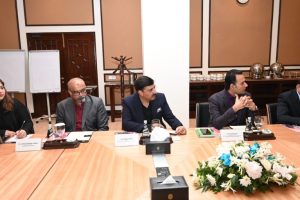
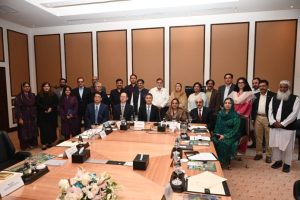
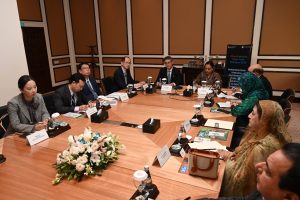
Speaking at the Pak–China Think Tank Dialogue on “Modernization through Partnership: China and Pakistan in Global Governance,” jointly organized by the Institute of Peace and Diplomatic Studies (IPDS) and the Academy of Contemporary China and World Studies (ACCWS), Gao said collaboration across government, academia, media, and civil society is vital for achieving shared prosperity and modernization.
He noted that both countries attach great importance to improving the well-being of their people through a pragmatic development approach that combines large-scale strategic projects with small but meaningful livelihood initiatives. “We are delivering tangible benefits at the grassroots level and improving people’s lives,” he said.
Highlighting China’s Global Governance Initiative (GGI) as a major public welfare effort for the international community, Gao said that expanding friendship and people-to-people connections between China and Pakistan would inspire further cooperation as both nations move forward on the path of modernization.
Emphasizing the role of ideas and narratives, Gao described think tanks and media as “dual engines” for sharing knowledge and exploring practical cooperation. Working together, he said, they can effectively tell the stories of how China and Pakistan are jointly advancing modernization and contributing to global governance.
In this context, Gao announced that CICG has signed a Memorandum of Understanding with IPDS to establish a joint research centre and a structured knowledge-sharing programme. The initiative will focus on areas including the Belt and Road Initiative (BRI), global governance, and regional studies. The centre, he said, aims to serve as a benchmark for China–Pakistan think tank collaboration and as a practical source of policy ideas for developing countries.
He also revealed plans for a long-term book publishing project to document and share the stories of China–Pakistan cooperation. Agreements have already been signed with publishers and content agencies in both countries. “This is not about publishing just a few books; it is a sustained strategy to promote mutual understanding through publishing, translation, and digital media,” he added.
Gao further said that communication networks can play a decisive role in removing barriers and deepening ties between the two “brotherly nations.” CICG, he noted, has built strong partnerships with mainstream Pakistani media to promote news exchanges, joint reporting, and content translation, enabling both sides to present their shared stories more effectively to domestic and international audiences.
Citing livelihood projects at Gwadar Port as a concrete example, Gao said such initiatives provide rich material for media engagement and symbolize the enduring friendship between China and Pakistan.
Addressing the dialogue, Chargé d’Affaires of the Embassy of the People’s Republic of China in Pakistan, Shi Yuanqiang, said the China–Pakistan partnership demonstrates how mutual trust, respect, and shared sacrifices can build lasting stability and friendship. He noted that both countries have consistently stood by each other during difficult times and continue to work together for regional peace, stability, and development.
Shi said flagship initiatives such as the China-Pakistan Economic Corridor (CPEC) not only strengthen economic cooperation but also help lay the foundation for peace through shared prosperity. He described CPEC as a living example of how strategic partnerships can transform economies, modernize infrastructure, create jobs, and uplift communities.
He also elaborated on the Global Governance Initiative, proposed by Xi Jinping, saying it envisions a more balanced, inclusive, and cooperative international order guided by principles of sovereign equality, respect for international law, multilateralism, people-centered development, and action-oriented cooperation.
According to Shi, the GGI complements China’s three other global initiatives—the Global Development Initiative (GDI), Global Security Initiative (GSI), and Global Civilization Initiative (GCI). “Together, these initiatives form a comprehensive framework for a fairer and more inclusive global order—one that resonates strongly with developing countries,” he said.
The dialogue was also addressed by Vice President of ACCWS Fan Daqi, former ambassador Masood Khan, and President of IPDS Dr Farhat Asif, among other speakers. The event brought together senior representatives from Pakistan’s leading organizations, media outlets, and think tanks, reflecting growing momentum for closer China–Pakistan cooperation in modernization, governance, and strategic communication.