


By Yawar Abbas
Beijing, Dec 24: — China’s enduring commitment to strengthening its partnership with Pakistan continues to stand as a strong example of how sustained cooperation and mutual trust can drive national progress and regional stability.
Beijing’s consistent support for Pakistan across economic, diplomatic and development spheres underscores the depth of the all-weather relationship. In this context, the recent visit of Prime Minister Shehbaz Sharif to China—now widely described by analysts as fruitful—was part of a broader coordination process aimed at expanding cooperation into new and emerging areas.
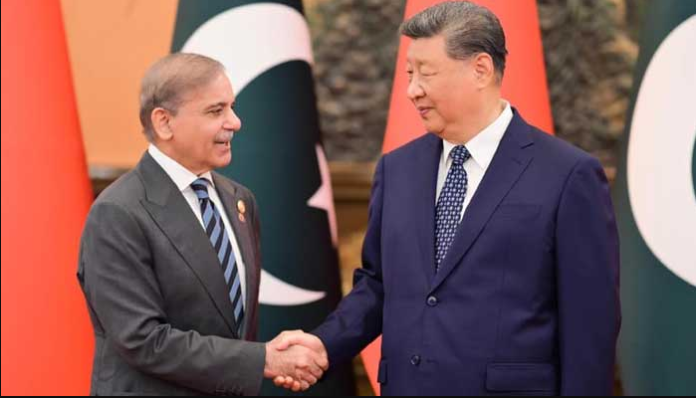
Analysts and international affairs experts said the meeting between President Xi Jinping and Prime Minister Shehbaz Sharif at the Great Hall of the People reaffirmed the iron-clad strategic cooperative partnership between the two countries at a critical juncture in regional and global politics. They noted that both leaders demonstrated a shared resolve to further consolidate bilateral ties through enhanced political trust and economic collaboration.
According to experts, President Xi highlighted that China and Pakistan share a resilient and brotherly bond built on trust and common values—an iron-clad friendship forged through historical challenges and strengthened over time. He emphasized that a robust China-Pakistan relationship is vital for regional peace and development, calling on both sides to accelerate the building of an even closer China-Pakistan community with a shared future in the new era for the benefit of both peoples and as a model for neighboring countries.
Experts said Prime Minister Shehbaz Sharif, during the visit, praised China’s remarkable economic and social achievements under President Xi’s leadership, particularly its success in poverty alleviation and improving public well-being. He also expressed appreciation for China’s consistent and unflinching support for Pakistan’s sovereignty, territorial integrity and socio-economic development.
Muhammad Asif Noor, Founder of the Friends of Belt and Road Initiative Forum and Advisor to the Pakistan Research Center at Hebei Normal University, described the engagement as highly significant in both bilateral and multilateral contexts. He noted that following the Pakistan-China Strategic Dialogue held earlier this year, the meeting represented a major step forward, providing Pakistan an early opportunity to express support for President Xi’s vision of global governance, economic globalization and world peace.
Noor, who also serves as Secretary General of the Pakistan-Shanghai Cooperation Organization Friendship Forum and Co-Founder of the Alliance of China-Pakistan Research Centers, said China’s approach to global governance—emphasizing territorial sovereignty, non-interference in internal affairs, respect for international law and dialogue over confrontation—aligns closely with Pakistan’s national interests. This alignment, he said, is likely to further elevate Pakistan’s diplomatic standing in Beijing and across SCO capitals.
In the bilateral context, Noor termed the meeting a breakthrough and a milestone ahead of the launch of the second phase of the China-Pakistan Economic Corridor (CPEC-2). He pointed to progress on upgrading the Pakistan-China Free Trade Agreement and the holding of the China-Pakistan B2B Investment Conference as positive indicators for increased foreign direct investment into Pakistan. “This will give fresh impetus to industrialization, job creation, investments and bilateral trade,” he said, adding that renewable energy, electric vehicles, agriculture cooperation, climate resilience and green development are key areas of future collaboration.
Sayed Ahmad Nadeem Qadri, an analyst and researcher on international affairs and the Belt and Road Initiative, said President Xi reaffirmed China’s readiness to support Pakistan’s home-grown development capacity. He noted that China expressed willingness to advance CPEC-2, upgrade the China-Pakistan Free Trade Agreement and expand cooperation in industry, agriculture and mining. Qadri said both leaders agreed that the unique and unparalleled nature of Pakistan-China relations should be reflected in deeper and more diversified cooperation.
Qadri added that Prime Minister Shehbaz Sharif acknowledged the China-Pakistan Economic Corridor as a flagship project of President Xi’s Belt and Road Initiative, emphasizing its role in strengthening the Pakistan-China community with a shared future. He said President Xi also assured continued Chinese assistance to Pakistan’s economic growth and development, particularly as the two countries enter the second phase of CPEC focusing on key economic sectors.
Commenting on the meeting, Malik Ayub Sumbal, a CGTN commentator and broadcaster in China, said President Xi underscored that strong Pakistan-China relations are essential for regional peace and development amid accelerating global changes. He noted that President Xi reaffirmed China’s commitment to enhancing CPEC and the China-Pakistan Free Trade Agreement, while Prime Minister Shehbaz reiterated Pakistan’s firm support for the one-China principle and pledged to deepen cooperation across all sectors.
Sumbal added that Prime Minister Shehbaz Sharif praised President Xi’s Global Governance Initiative as an important step toward global peace and stability, reaffirming Pakistan’s commitment to actively support and implement it.
Senior journalist and international affairs analyst Mateen Haider described the engagement as extraordinary, noting that Pakistan and China remain in close contact at the highest levels. He said a range of important issues, including CPEC-2, were discussed, and emphasized that the timing of the meeting was particularly significant amid rapidly evolving geopolitical developments.
“It was an excellent and timely engagement,” Haider said, adding that as strategic partners, Pakistan and China must remain closely aligned. He noted that recent high-level exchanges, including visits by senior Chinese officials to Pakistan, have reinforced mutual understanding and ensured that bilateral cooperation continues to move forward in a coordinated and strategic manner.
The writer is a senior journalist, researcher and analyst who has written extensively on China.